
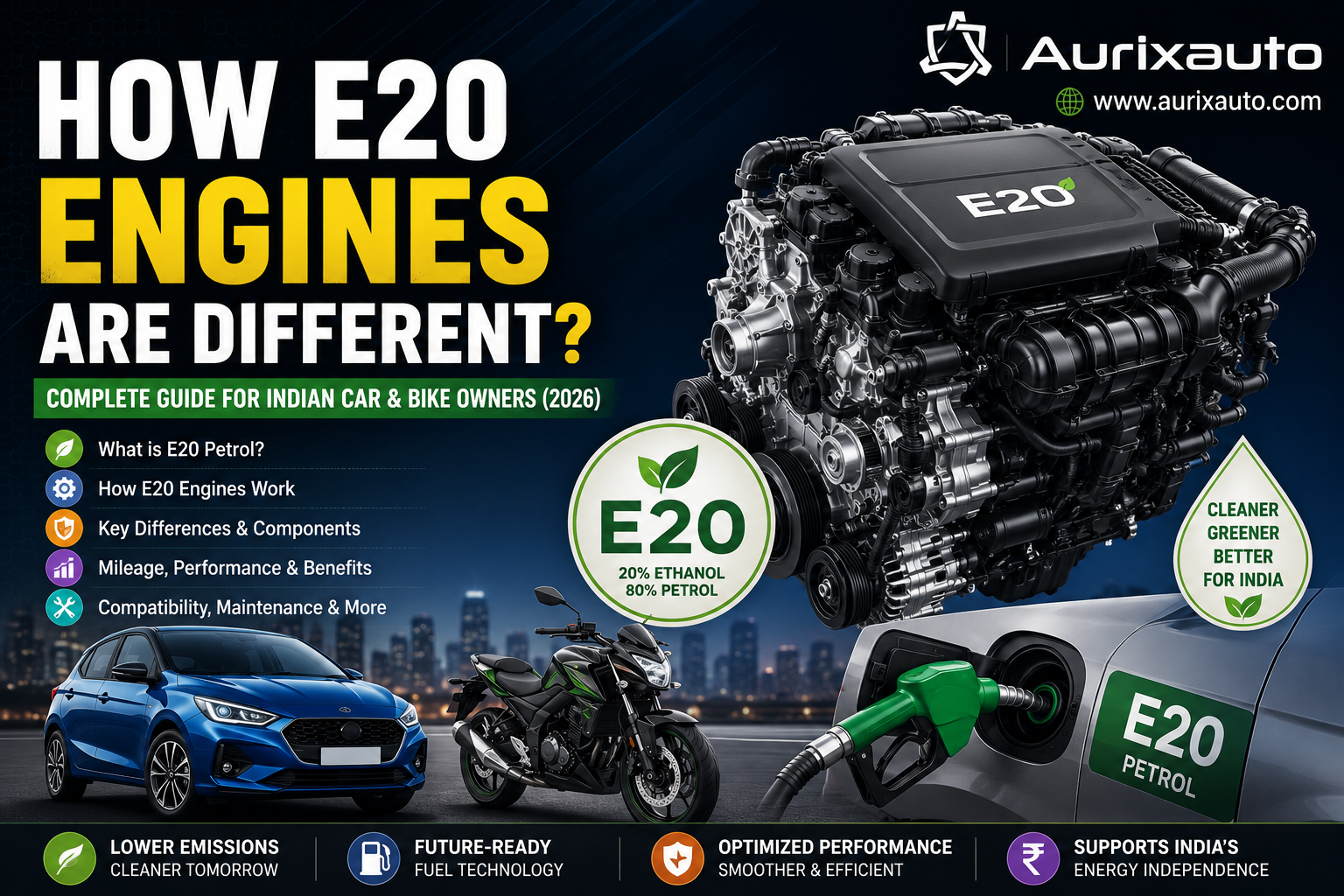
How E20 Engines Are Different? Complete Guide for Indian Car & Bike Owners (2026)
Last Updated: July 2026
🚗 Quick Summary
India is gradually transitioning towards E20 petrol as part of its clean mobility mission. Many new petrol cars and motorcycles are now designed to run on E20 fuel, but many owners still wonder how E20 engines differ from traditional petrol engines. This guide explains everything in simple language—from engine components and compatibility to mileage, maintenance, advantages, disadvantages and manufacturer support.

What is E20 Petrol?
E20 petrol is a blend containing 20% ethanol and 80% petrol. Ethanol is a renewable biofuel produced mainly from sugarcane, maize and agricultural waste. By blending ethanol with petrol, India aims to reduce crude oil imports, lower carbon emissions and promote sustainable transportation.
Unlike regular petrol, ethanol contains oxygen, burns cleaner and has a higher octane rating. However, it also absorbs moisture and behaves differently inside the fuel system, requiring some engine components to be upgraded.
How Are E20 Engines Different?
An E20 engine is not a completely different engine. Instead, manufacturers modify several components so the vehicle can safely use petrol containing up to 20% ethanol without affecting reliability or warranty.
| Component | Regular Petrol Engine | E20 Compatible Engine |
|---|---|---|
| Fuel Pipes | Standard Rubber | Ethanol Resistant Material |
| Fuel Tank | Normal Coating | Corrosion Resistant Material |
| Fuel Pump | Standard Design | Improved Ethanol Compatible Pump |
| Fuel Injectors | Petrol Calibration | Optimized Fuel Injection Mapping |
| ECU Software | Petrol Programming | E20 Fuel Calibration |
| Rubber Seals | Standard Rubber | Alcohol Resistant Seals |
Why Do These Changes Matter?
Ethanol has different chemical properties compared to petrol. It attracts moisture, can corrode unsuitable materials and requires slightly different combustion settings. Manufacturers therefore update:
- Fuel hoses and seals
- Fuel injectors
- Engine Control Unit (ECU)
- Fuel pump
- Combustion calibration
- Cold start programming
These improvements ensure smooth performance, durability and compliance with emission norms.
E20 Engine vs Regular Petrol Engine
| Feature | Regular Petrol | E20 Engine |
|---|---|---|
| Fuel Supported | E0–E10 | Up to E20 |
| Emission Level | Higher | Lower |
| Fuel System | Standard | Modified |
| ECU Mapping | Petrol | E20 Optimized |
| Environmental Impact | Higher | Reduced Carbon Footprint |
Which Car Brands Support E20?
Most manufacturers have started introducing E20-compatible petrol vehicles. Compatibility depends on the manufacturing year and model.
- ✔ Maruti Suzuki
- ✔ Hyundai
- ✔ Tata Motors
- ✔ Mahindra
- ✔ Kia
- ✔ Toyota
- ✔ Honda
- ✔ Volkswagen
- ✔ Škoda
- ✔ Renault
- ✔ Nissan
- ✔ MG Motor
- ✔ Citroën
- ✔ Jeep
Always verify compatibility through your owner's manual, fuel lid sticker or authorised dealership.
Can Bikes Use E20 Petrol?
Many new motorcycles launched after 2023 are being developed with E20 compatibility. Several manufacturers including Hero MotoCorp, Honda, Bajaj, TVS, Yamaha and Suzuki have announced E20-ready models.
Older motorcycles should only use E20 fuel if officially approved by the manufacturer.
Does E20 Reduce Mileage?
Since ethanol contains slightly less energy than petrol, some vehicles may experience a small reduction in mileage. In real-world driving, the difference is generally between 2–5%, depending on driving style, engine tuning and vehicle condition.
Petrol Mileage: 20 km/l
Estimated E20 Mileage: 19–19.5 km/l
Benefits of E20 Engines
- 🌿 Lower emissions
- ⛽ Reduced dependence on imported crude oil
- 🇮🇳 Supports India's biofuel mission
- ⚙ Cleaner combustion
- 💨 Reduced carbon monoxide emissions
- 🚗 Future-ready technology
Limitations
- Slight reduction in mileage
- Older vehicles may not support E20 fuel
- Fuel system parts must be ethanol compatible
- Always follow manufacturer recommendations
Maintenance Tips for E20 Vehicles
- Use fuel from trusted petrol pumps.
- Follow scheduled servicing.
- Replace fuel filters on time.
- Inspect fuel hoses during service.
- Do not store E20 fuel for long periods.
- Use recommended engine oil.
- Check for manufacturer software updates.
Myths vs Facts
| Myth | Fact |
|---|---|
| E20 damages every engine. | No. Only non-compatible vehicles may face issues. |
| Mileage drops by 20%. | Usually only 2–5%. |
| E20 is unsafe. | E20 is safe for approved vehicles. |
| E20 requires special servicing. | Normal servicing is sufficient. |
Keep Your E20 Vehicle Looking New with AurixAuto
Whether you own a Petrol, Diesel or E20-compatible vehicle, proper maintenance keeps it running efficiently and looking great.
Recommended Products
- ✔ Waterless Car Wash Spray
- ✔ Windshield Washer Tablets
- ✔ Dashboard Polish
- ✔ Tyre Polish
- ✔ Premium Microfiber Cloth
- ✔ Scratch Remover
Explore premium car care products from AurixAuto.
Frequently Asked Questions
Can I use E20 petrol in my old car?
Only if your manufacturer has approved E20 compatibility.
Will E20 affect engine life?
No. E20-compatible vehicles are designed for long-term use with E20 fuel.
Does E20 improve performance?
Performance remains largely similar, with cleaner combustion and lower emissions.
Is E20 petrol available across India?
Availability is expanding as part of the Government of India's ethanol blending programme.
Final Thoughts
E20 engines are an important step toward cleaner and more sustainable mobility in India. While they appear similar to conventional petrol engines, they incorporate improved fuel system materials, updated ECU programming and optimized combustion to safely handle ethanol-blended fuel. If your vehicle is E20 compatible, you can confidently use E20 petrol while enjoying reduced emissions and supporting India's energy independence.
Disclaimer: E20 compatibility depends on the manufacturer, model and production year. Always verify your vehicle's fuel compatibility through the owner's manual or an authorised dealership before using E20 petrol.