Think about how your smartphone has changed over the last five years. You bought it with a particular set of features, but software updates have added new functions, improved security, changed the interface and sometimes even made the phone feel like a completely different device.
Something similar is now happening with cars.

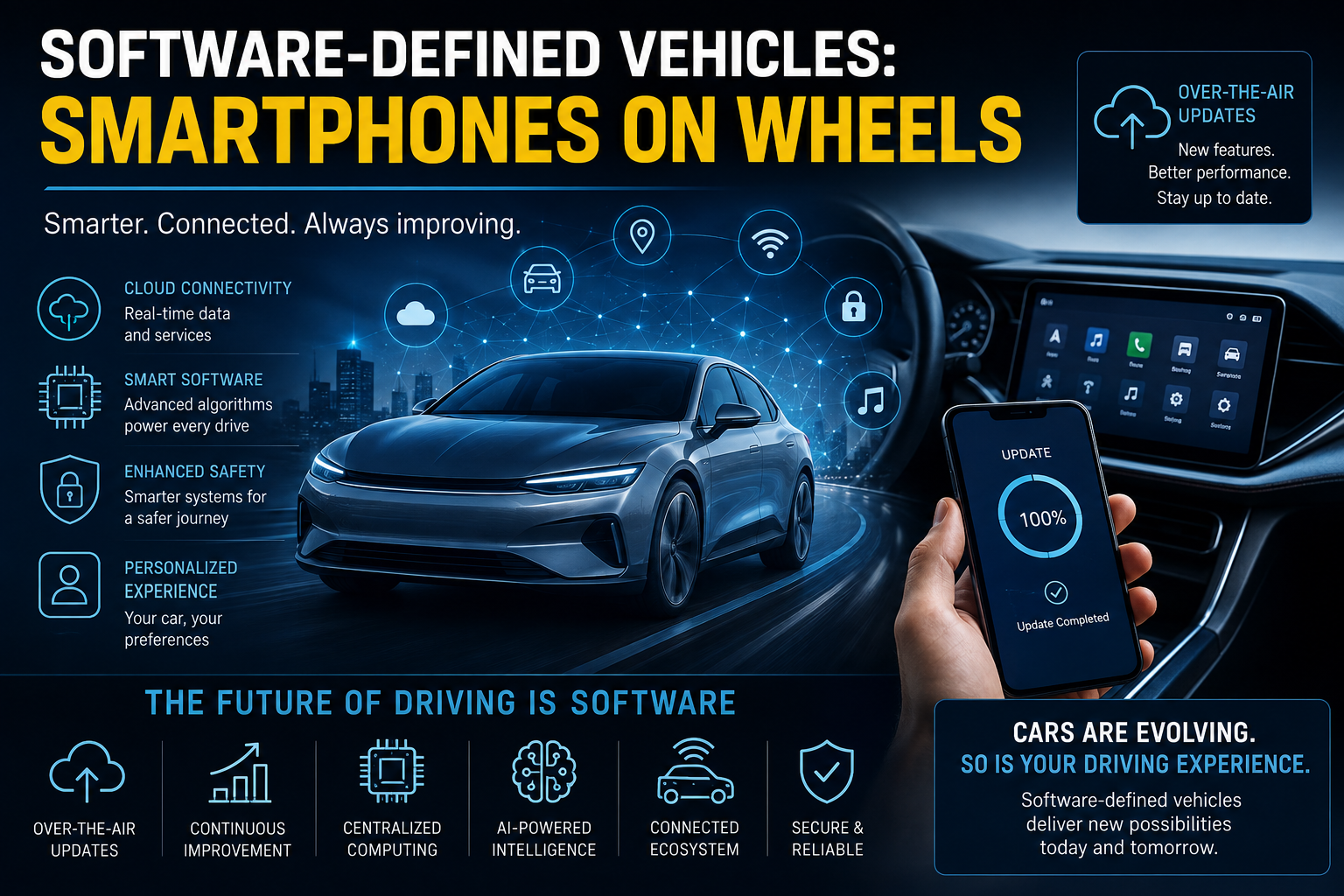
Modern cars are no longer just machines made of an engine, gearbox, tyres and mechanical parts. They are increasingly connected computers with sensors, cameras, processors and software working together behind the scenes.
This new type of vehicle is called a Software-Defined Vehicle (SDV).
In simple words, a software-defined vehicle is a car where software plays a much bigger role in deciding how the vehicle works, what features it offers and how those features can improve over time.
That is why you may hear people say that cars are becoming "smartphones on wheels."

What Is a Software-Defined Vehicle?
Let's keep the technical language aside for a moment.
In a traditional car, most features are closely tied to the physical hardware installed in the vehicle. If you wanted a major change, you often needed a new component, a service visit or even a new model.
A software-defined vehicle takes a different approach.
The hardware is still extremely important, but software increasingly controls functions such as infotainment, navigation, driver assistance, battery management, connectivity, climate control and many other vehicle systems.
The big difference is that software can be improved after the car has left the showroom.
This means your vehicle can potentially receive software updates, bug fixes, security improvements and new features without requiring a traditional workshop visit.
Why Are Cars Moving Towards Software?
The automotive industry has changed dramatically in the last decade.
Electric vehicles, connected-car technology, artificial intelligence, advanced driver assistance systems and smartphone integration have all increased the amount of software inside modern vehicles.
According to the International Energy Agency, software-defined vehicles are becoming an important part of the automotive industry's shift toward vehicles that can be continuously updated and enhanced.
For car manufacturers, software also provides something that traditional hardware cannot easily offer: continuous improvement.
Instead of treating a car as a finished product on the day it is delivered, manufacturers can increasingly treat it as a platform that evolves throughout its life.
How Are Software-Defined Vehicles Different From Normal Cars?
The easiest way to understand the difference is to compare a traditional car with a modern smartphone.
- Traditional car: Most features remain largely unchanged after purchase.
- Connected car: The vehicle can communicate with smartphones, cloud services and the internet.
- Software-defined vehicle: Software becomes a central part of the vehicle's architecture and can control, manage and improve a growing range of functions.
It is important to remember that simply having Wi-Fi, Bluetooth or a touchscreen does not automatically make a vehicle a full software-defined vehicle. SDVs involve a deeper change in how the vehicle's electronic and software systems are designed.
Over-the-Air Updates: The Feature That Makes Cars More Like Smartphones
One of the biggest reasons for the "smartphone on wheels" comparison is Over-the-Air (OTA) updates.
You already use OTA updates on your phone. You receive a notification, connect to Wi-Fi or mobile data, install the update and your device gets new software.
Modern connected vehicles can use a similar concept.
Instead of visiting a service centre for every software improvement, an eligible vehicle can receive certain updates remotely.
Depending on the vehicle and manufacturer, these updates may improve infotainment, navigation, connectivity, driver assistance features, battery management or other software-controlled functions.
OTA technology is therefore becoming one of the most important building blocks of the software-defined vehicle.
Industry research also highlights the growing importance of secure OTA updates because vehicle software is becoming more connected and increasingly complex.
What Can Software Actually Change in a Car?
This is where things get interesting.
Software can influence many parts of the driving and ownership experience.
- Infotainment and touchscreen features
- Navigation and map data
- Voice assistants
- Smartphone connectivity
- Driver assistance systems
- Battery management in electric vehicles
- Charging-related functions
- Vehicle diagnostics
- Security updates
- Climate and comfort functions
- Digital keys and connected services
Not every vehicle supports every function, and safety-critical systems have much stricter requirements. But the overall direction is clear: software is becoming an increasingly important part of the car.

Cars Can Get Better After You Buy Them
This could be one of the biggest changes for car owners.
Imagine buying a car today and receiving improvements several months later without changing the physical parts.
A manufacturer could potentially fix a software issue, improve an existing feature or introduce a new digital service through an update.
This is already changing the way people think about vehicle ownership.
Instead of asking only, "What features does this car have?", buyers may increasingly ask:
- How long will the software be supported?
- How frequently will updates be released?
- Which features can be upgraded later?
- Will new software features cost extra?
- How secure is the vehicle's software?
- Will the vehicle continue receiving updates for many years?
These questions could become just as important as engine power, mileage and boot space.
Electric Vehicles Are Helping Accelerate the Change
Electric vehicles have played an important role in the growth of software-defined vehicle technology.
An EV already depends heavily on software for areas such as battery management, charging, energy consumption, thermal management and range calculations.
That makes software an important part of the vehicle's performance.
The IEA notes that the growth of EVs has accelerated the transition toward software-based vehicle control and more centralized electronic architectures.
However, this does not mean software-defined vehicles will only be electric cars.
Petrol and diesel vehicles can also use connected services, advanced driver assistance, digital dashboards, OTA updates and other software-driven technologies.
What Does This Mean for Indian Car Buyers?
For Indian car buyers, this trend is already becoming relevant.
Modern cars in India are coming with increasingly advanced infotainment systems, connected-car applications, smartphone integration, cameras, sensors, ADAS and digital features.
Indian consumers are also showing strong interest in these technologies. Deloitte India's 2026 automotive consumer study found that around 95% of surveyed Indian consumers were willing to pay for software-defined vehicle capabilities.
But there is another important point.
A smarter car still needs basic care.
No matter how advanced the software becomes, your car still has paint, glass, tyres, dashboard surfaces, seats and other physical components that need regular maintenance.
Keeping your vehicle clean and well maintained remains an important part of ownership.
For example, a simple microfiber car duster can be useful for removing everyday dust from the exterior and interior, while a 5-in-1 car care kit can help with routine cleaning and maintenance.

Smart Technology Does Not Replace Car Maintenance
This is something car owners should not forget.
Your car may have a powerful processor, connected navigation and advanced sensors, but regular physical maintenance is still necessary.
Tyres still need the correct pressure. Glass needs to remain clean. Cameras and sensors need to be unobstructed. The interior needs regular cleaning. Paint needs protection from dust, dirt and environmental contaminants.
In fact, as vehicles become more dependent on cameras and sensors, keeping the areas around those components clean can become even more important.
For quick cleaning between full washes, a waterless car wash solution can be a convenient option for removing light dust and everyday grime.
Are Cars Really Becoming Smartphones on Wheels?
Yes — but there is an important difference.
A smartphone can usually be replaced every few years. A car is expected to last much longer.
That creates a major challenge for automakers.
Car manufacturers need to make sure the software remains secure, compatible and supported for many years. They also need to ensure that software updates do not compromise safety or reliability.
In other words, a car cannot simply be treated like a giant smartphone.
It needs the flexibility of modern technology while maintaining the reliability, safety and durability expected from a vehicle.
The Rise of Central Computers and Zonal Architecture
There is another major change happening behind the scenes.
Traditional cars can have many electronic control units, with different computers handling different functions.
Newer software-defined vehicle architectures are moving toward fewer, more powerful computing systems and "zonal" architectures.
Instead of having a separate electronic controller for almost every function, more computing can be handled centrally and communicated across the vehicle.
This can reduce wiring complexity and make it easier for manufacturers to develop and update software.
The IEA identifies the move from distributed electronic control units toward domain and zonal architectures as an important part of the software-defined vehicle transition.
What About Artificial Intelligence?
AI is expected to make software-defined vehicles even smarter.
Artificial intelligence can help vehicles understand information from cameras and sensors, improve driver assistance, personalise the driving experience and analyse vehicle data.
In the future, your car may understand your preferences more naturally, predict maintenance requirements and automatically adjust certain settings based on your driving habits.
However, AI in cars also brings new questions around safety, privacy, cybersecurity and reliability.
So the future is not simply about putting AI into every car. It is about using AI where it can provide a genuine benefit without compromising safety.
What Are the Biggest Challenges?
Software-defined vehicles offer plenty of advantages, but they also introduce new challenges.
1. Cybersecurity
A connected car needs strong protection against cyber threats. The more connected systems a vehicle has, the more important software security becomes.
2. Software Bugs
A software problem can affect thousands or even millions of vehicles. Manufacturers therefore need extensive testing before releasing updates.
3. Long-Term Support
A car may stay on the road for 10, 15 or even 20 years. Manufacturers need to think about software support for much longer than they typically would for consumer electronics.
4. Privacy
Connected vehicles can generate large amounts of information. Owners will increasingly want to know what data is collected, how it is used and who can access it.
5. Paid Features
Some manufacturers are exploring subscription-based or software-enabled features. This could give customers more choice, but it also raises an obvious question: should a feature already installed in your car require a monthly payment?
What Will the Car of the Future Look Like?
The future car may be less about adding more buttons and more about making the entire driving experience connected.
You could start your journey with your preferred settings already loaded, receive real-time traffic information, use voice commands naturally, get automatic software updates and access new digital features during the vehicle's lifetime.
The physical car will still matter. But the software running inside it could become one of the biggest factors separating one vehicle from another.
This is why technology companies, automakers and automotive suppliers are investing heavily in vehicle software platforms.
Final Thoughts
The idea of a "smartphone on wheels" may sound like a catchy technology phrase, but the change behind it is very real.
Cars are becoming more connected, software-driven and updateable. Electric vehicles are accelerating the trend, while AI, cloud services, advanced sensors and OTA updates are pushing automotive technology even further.
For car buyers, this means the definition of a "good car" is changing.
Engine performance, mileage, safety and comfort will always matter. But software support, connectivity, digital features, cybersecurity and the ability to improve over time are becoming increasingly important too.
And even as cars become more like computers, one thing will not change: they still need good old-fashioned care.
From keeping the dashboard clean to protecting the exterior, choosing the right car accessories and car care products can help keep your vehicle looking and feeling its best.
As the automobile moves from a machine that stays the same to a platform that can evolve, the future of driving is becoming more digital — one software update at a time.
Related Resources & Backlink Opportunities
For readers who want to explore the technology behind this change, the International Energy Agency has published detailed research on vehicle software and software-defined vehicles. Deloitte has also studied software-defined vehicle readiness and consumer demand, including specific insights from India.
For additional automotive technology reading, useful external references include automotive software research, OTA update technology and connected vehicle security studies.