New Car Delivery Checklist 2026: 50 Things to Check Before Taking Delivery
Buying a new car is an exciting experience, but taking delivery without checking the vehicle properly can lead to problems later. A proper new car delivery checklist helps you inspect the car, verify documents, check features and identify any damage before accepting delivery.
Whether you are buying a hatchback, sedan, SUV, MPV or electric car, spending 30–60 minutes on a detailed inspection can save you from unnecessary trouble. From the VIN and manufacturing date to tyres, paint, lights, interiors, accessories and paperwork, every important area should be checked before signing the delivery documents.
Why Is a New Car Delivery Inspection Important?
A new car should ideally be delivered in perfect condition. However, cars can sometimes remain in stock for several months, get exposed to weather, or develop minor scratches and other issues while being transported or moved around the dealership.
A pre-delivery inspection (PDI) allows you to verify that the vehicle you are receiving matches the car you booked and that all promised features, accessories and documents are available.
Do not feel rushed by the dealership. Complete the inspection during daylight or in a well-lit area and preferably before making the final delivery acceptance.
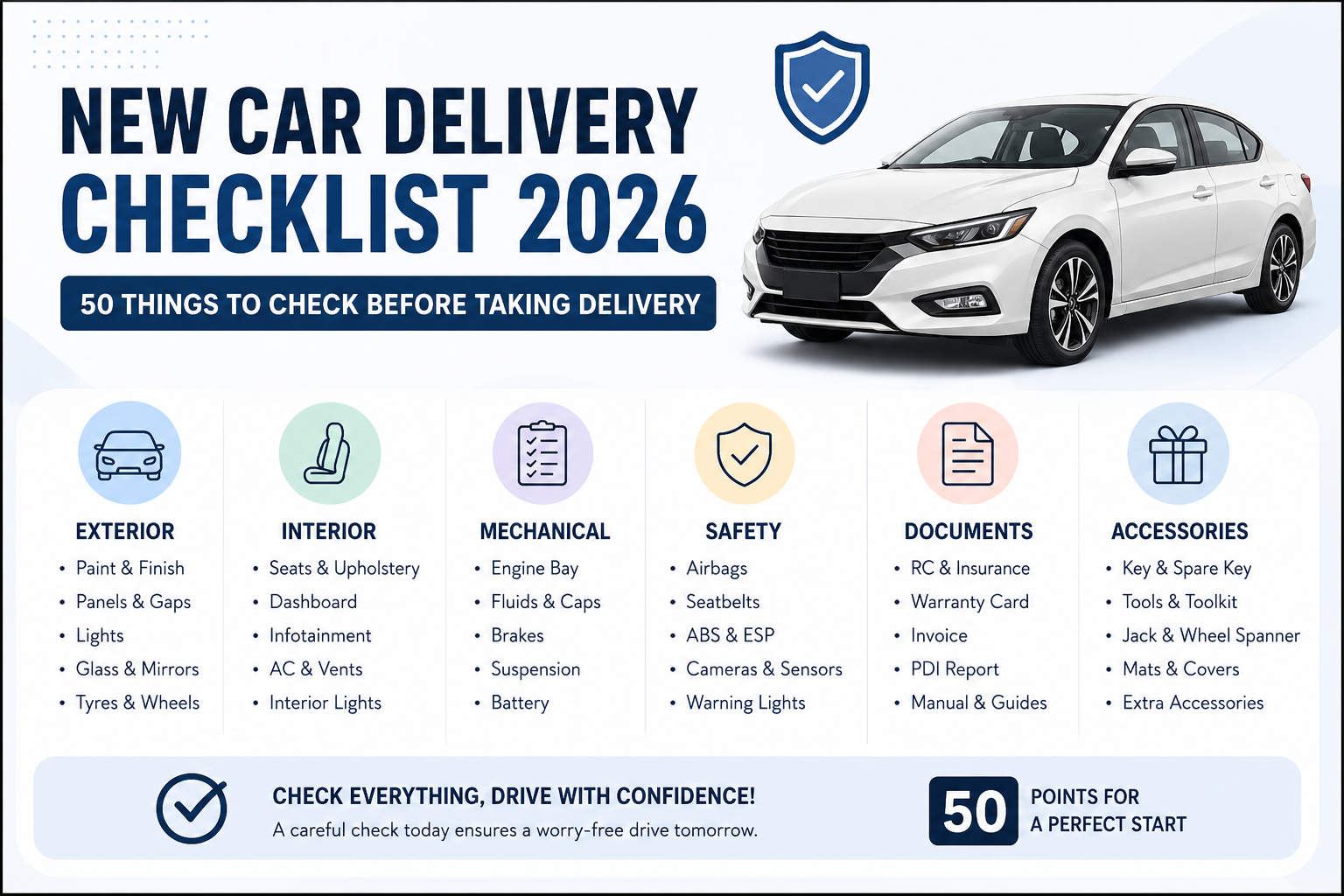
New Car Delivery Checklist: 50 Things to Check
1. Verify the Car's VIN Number
Check the Vehicle Identification Number (VIN) on the car against the VIN mentioned on your invoice, insurance documents and other paperwork.
2. Check the Manufacturing Month and Year
Confirm the manufacturing date. A recently manufactured vehicle is generally preferable, especially if the car has been sitting in dealership stock for several months.
3. Confirm the Variant
Make sure the car is the exact variant you booked. Check the model, trim level and specifications carefully.
4. Check the Exterior Colour
Verify that the colour matches your booking and invoice. Check the body carefully for differences in shade or paint finish.
5. Inspect the Odometer Reading
A new car can have a small number of kilometres because of transportation, testing and dealership movement. Check the odometer and ask the dealer about an unusually high reading.
6. Inspect the Paint Quality
Walk around the entire vehicle and look for scratches, dents, swirl marks, paint chips, uneven finish or signs of repainting.
7. Check Body Panel Gaps
Look at the gaps between the bonnet, doors, boot and other body panels. They should appear reasonably uniform.
8. Check the Front Bumper
Inspect the front bumper for scratches, cracks, loose sections or damage caused during transportation.
9. Check the Rear Bumper
Inspect the rear bumper and surrounding areas for scratches, dents and fitting issues.
10. Inspect the Bonnet
Open and close the bonnet to check its alignment and operation. Look underneath for any visible damage or leaks.
11. Inspect All Doors
Open and close every door several times. Check for smooth operation, unusual noises and proper locking.
12. Check Door Handles and Locks
Test exterior and interior door handles, central locking and keyless entry if equipped.
13. Inspect the Boot or Tailgate
Check the boot or powered tailgate for smooth operation and proper alignment.
14. Check the Roof
Inspect the roof for scratches, dents, paint damage and any signs of transportation-related damage.
15. Inspect the Windshield
Look closely at the windshield for cracks, chips or scratches. Also check the rear glass and all other windows.
16. Check ORVMs
Test both outside rear-view mirrors. If electrically adjustable or folding, verify that all functions work properly.
17. Inspect the Headlamps
Turn on the low beam, high beam, DRLs and other available lighting functions. Check for cracks or condensation inside the lamps.
18. Check Tail Lamps
Verify that all rear lights, brake lights, indicators and reverse lights function correctly.
19. Check Turn Indicators
Operate the front and rear indicators and confirm that they are functioning normally.
20. Inspect the Wheels
Check alloy wheels or steel rims for scratches, dents or damage. Make sure the wheel design matches the selected variant.
21. Check Tyre Condition
Inspect all four tyres for cuts, bulges, cracks or unusual wear. Check the tyre manufacturing date if required.
22. Check Tyre Pressure
Verify that tyre pressures are set according to the manufacturer's recommended specifications.
23. Check the Spare Wheel or Tyre Repair Kit
Depending on the car, verify that the spare wheel, puncture repair kit, tyre inflator or sealant is provided.
24. Check the Jack and Tool Kit
Confirm that the jack, wheel wrench, towing hook and other supplied tools are present.
25. Inspect the Interior
Check the dashboard, seats, door panels, roof liner and carpets for stains, scratches, cuts or manufacturing defects.
26. Check the Seat Condition
Inspect all seats for tears, marks, loose stitching or other damage.
27. Test Seat Adjustment
Check manual or electric seat adjustment functions. If the car has powered or memory seats, test all available controls.
28. Check Seat Belts
Pull and release every seat belt and check that the buckles lock properly.
29. Test the Infotainment System
Turn on the touchscreen system and check the display, menus, audio system, Bluetooth, USB ports and smartphone connectivity.
30. Check the Instrument Cluster
Start the car and look for warning lights or error messages. The cluster should not display unexplained warning indicators.
31. Test the Air Conditioner
Turn the AC on and test different temperature, fan-speed and airflow settings. Make sure cooling starts normally.
32. Check the Heater and Defogger
Where applicable, test the heater, front defogger and rear defogger functions.
33. Test All Power Windows
Open and close every power window from both the individual switches and the driver's control panel.
34. Check the Horn
Test the horn and make sure it produces a consistent sound.
35. Test the Wipers and Washer
Operate the front and rear wipers, washer jets and different wiper speeds. Check that washer fluid sprays correctly.
36. Check the Interior Lights
Test cabin lights, reading lamps, boot lights and other interior illumination.
37. Test the Central Locking
Lock and unlock the vehicle using the key, remote or smart key system. Confirm that all doors respond correctly.
38. Check the Key Fobs
Verify that all supplied keys and remote functions work properly. Check that the number of keys matches the manufacturer's standard equipment.
39. Test the Parking Sensors
If equipped, test the front and rear parking sensors. Check whether the system detects obstacles correctly.
40. Test the Reverse Camera
Engage reverse and check the camera image, display quality and parking guidelines.
41. Check ADAS Features
If the car has Advanced Driver Assistance Systems, verify that the relevant functions are activated and that there are no warning messages related to the sensors or cameras.
42. Check the Airbags
Confirm that the airbag warning indicator behaves normally after starting the vehicle and that no unexplained airbag warning remains illuminated.
43. Inspect the Engine Bay
Open the bonnet and check for obvious fluid leaks, loose components, damaged wiring or unusual conditions. The engine bay should look clean and properly assembled.
44. Check Engine Oil and Other Fluids
Ask the dealership to confirm that engine oil, coolant, brake fluid and windshield washer fluid are at appropriate levels.
45. Start the Engine
Start the vehicle and listen for unusual knocking, rattling, excessive vibration or warning sounds.
46. Take a Short Test Drive
If dealership policy allows, take a short drive to check steering, brakes, acceleration, gear shifts, suspension and overall vehicle behaviour.
47. Check the Brakes
During the test drive, ensure that the brake pedal feels normal and that the vehicle does not pull significantly to one side while braking.
48. Verify Accessories
Check every accessory promised during booking, such as floor mats, mud flaps, boot mat, seat covers, dashcam or other dealer-fitted accessories.
49. Verify All Documents
Before leaving the dealership, check the invoice, insurance, registration-related documents, warranty information, owner's manual, service booklet and other relevant paperwork.
50. Check the Delivery Kit
Finally, confirm that you receive all items supplied with the vehicle, including both keys, owner's manual, warranty documents, tool kit, emergency equipment and any other applicable accessories.
Quick New Car PDI Checklist
| Category | What to Check |
|---|---|
| Documents | Invoice, VIN, insurance, registration, warranty |
| Exterior | Paint, dents, scratches, panel gaps, glass |
| Tyres | Condition, pressure, spare wheel and tools |
| Interior | Seats, dashboard, carpets, controls |
| Electronics | Infotainment, camera, sensors, lights, USB ports |
| Mechanical | Engine, fluids, brakes, steering and suspension |
| Accessories | Floor mats, mud flaps and promised accessories |
| Keys | All supplied keys and remote functions |
Documents to Check Before New Car Delivery
- Final invoice
- Vehicle Identification Number (VIN)
- Insurance policy
- Registration-related documents
- Warranty documents
- Owner's manual
- Service booklet or digital service information
- Roadside assistance information, if applicable
- Finance and loan documents, if applicable
- Accessory invoice, if applicable
Things to Check Specifically for an Electric Car
If you are taking delivery of an EV, add a few additional checks to your new car delivery checklist 2026.
- Check the battery state of charge.
- Verify the charging cable and accessories.
- Inspect the charging port.
- Check AC and DC charging compatibility as applicable.
- Confirm that the EV displays no battery-related warning.
- Check the manufacturer's connected-car application if provided.
- Verify the stated battery and warranty documentation.
- Check the tyre repair kit or spare wheel arrangement.
What to Do If You Find a Problem During PDI?
If you notice scratches, dents, missing accessories, incorrect specifications or any mechanical/electrical issue, do not ignore it. Take clear photographs and inform the dealership immediately.
Ask the dealer to record the issue in writing and provide a clear resolution before accepting delivery. For significant damage or a major mismatch between the booked and delivered vehicle, discuss the matter with the dealership management before signing the final delivery acceptance.
Best Time to Perform a Pre-Delivery Inspection
The best time to inspect a new car is before taking final delivery. Daylight is preferable because small scratches, paint defects and dents are easier to identify under natural light.
If possible, carry a friend or family member with you. One person can operate the controls while the other checks the exterior and interior.
Final New Car Delivery Checklist 2026
A new car delivery should not be treated as just a ceremonial handover. Your vehicle is a major purchase, so taking time for a proper inspection is important. Check the VIN, manufacturing date, exterior, tyres, interiors, electrical functions, engine bay, documents, accessories and safety features before accepting the vehicle.
A detailed new car delivery checklist can help you identify problems early and ensure that the car you receive matches what you paid for. Once everything is verified and documented, you can complete the paperwork and enjoy your new car with greater peace of mind.
FAQs About New Car Delivery Checklist
1. What should I check before taking delivery of a new car?
Check the VIN, manufacturing date, odometer, paint, body panels, tyres, lights, interiors, infotainment, AC, brakes, accessories and all vehicle documents.
2. What is PDI in a new car?
PDI stands for Pre-Delivery Inspection. It is the process of checking a vehicle's condition, specifications, features and documents before accepting delivery from the dealership.
3. How many kilometres should a new car have at delivery?
A small odometer reading can be normal because the vehicle may have been driven for transportation, testing or dealership movement. If the reading appears unusually high, ask the dealer for an explanation.
4. Should I check the manufacturing date before buying a car?
Yes. Checking the manufacturing month and year helps you understand how long the vehicle has been in stock and allows you to make a more informed purchase decision.
5. Can I reject a car after finding damage during PDI?
If you discover significant damage or a mismatch before accepting delivery, discuss it with the dealership before signing the final delivery documents. The appropriate resolution can depend on the nature of the issue and the purchase agreement.