
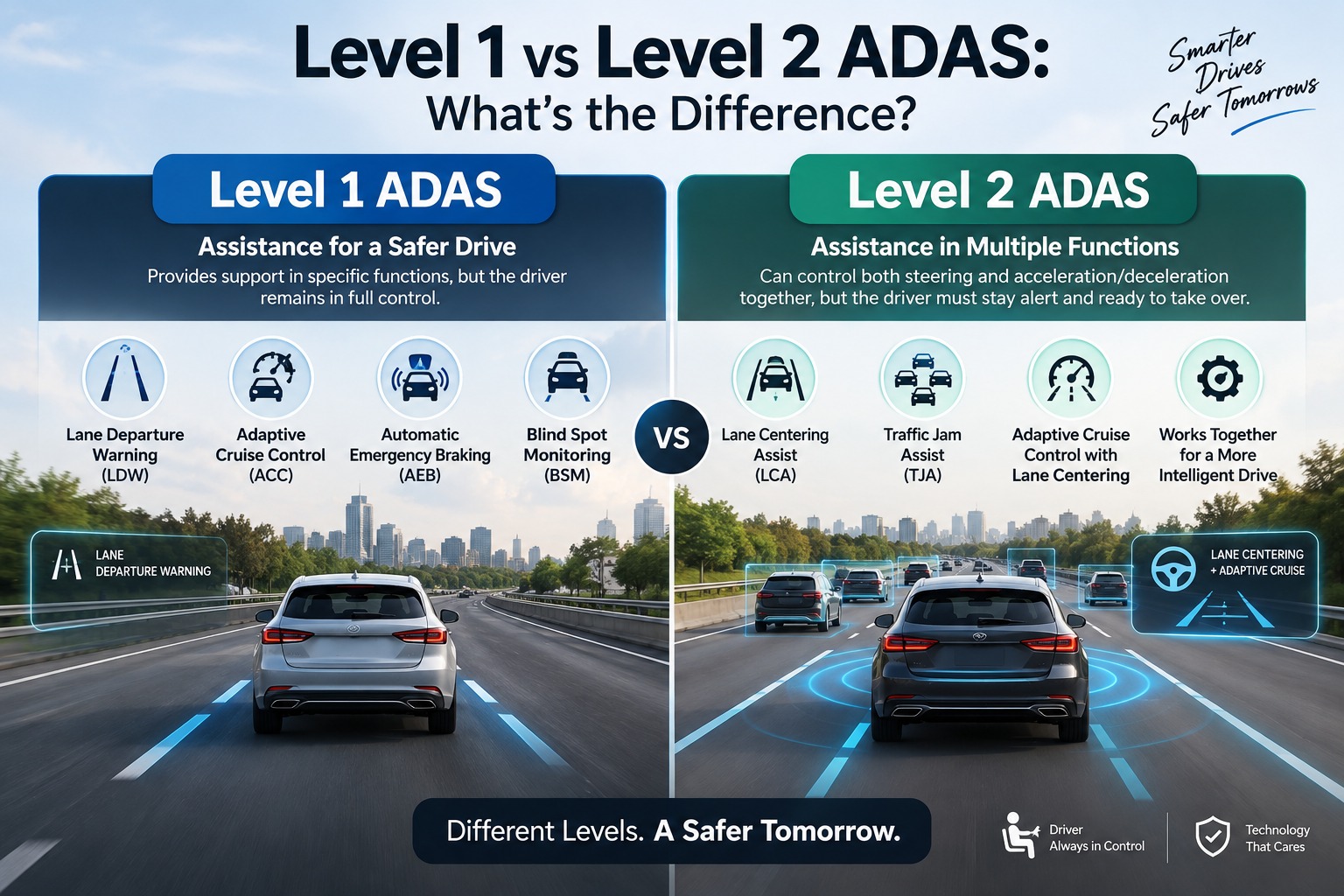
Level 1 vs Level 2 ADAS: What's the Difference?
Advanced Driver Assistance Systems (ADAS) are becoming increasingly common in modern vehicles. These technologies are designed to help drivers monitor the road, maintain vehicle control, and respond to potential hazards. However, not all ADAS features provide the same level of assistance.
Two commonly discussed categories are Level 1 and Level 2 ADAS. The key difference is how many driving functions the system can assist with at the same time and how much responsibility remains with the driver. Understanding this distinction can help drivers make better-informed decisions when choosing a vehicle equipped with driver assistance technology.

What Is ADAS?
ADAS stands for Advanced Driver Assistance Systems. It refers to a group of vehicle technologies that assist drivers with tasks such as steering, braking, acceleration, maintaining a safe following distance, and monitoring surrounding traffic.
Examples of ADAS features include adaptive cruise control, lane keeping assistance, automatic emergency braking, blind-spot monitoring, and parking assistance.
ADAS is intended to support the driver rather than eliminate the need for active human supervision. The driver generally remains responsible for monitoring the driving environment and controlling the vehicle.
What Is Level 1 ADAS?
Level 1 automation is commonly described as driver assistance. At this level, the vehicle can assist with either steering or acceleration and braking, but generally not both simultaneously as a coordinated driving function.
For example, a vehicle may provide adaptive cruise control that automatically adjusts speed to maintain a selected following distance. Alternatively, it may offer lane-centering or lane-keeping assistance that provides steering support.
However, the driver remains responsible for the other aspects of driving and must continuously monitor the road.
Common Level 1 Features
- Adaptive cruise control
- Lane keeping or lane-centering assistance
- Automatic emergency braking
- Forward collision warning
- Blind-spot monitoring
Not every feature listed above necessarily determines the automation level by itself. The classification depends on the driving functions the system performs and how those functions are integrated.
What Is Level 2 ADAS?
Level 2 automation provides assistance with both steering and speed control under certain conditions. This means the vehicle can potentially maintain its position within a lane while also accelerating, braking, or adjusting speed.
For example, a Level 2 system may combine adaptive cruise control with lane-centering assistance. The vehicle can help maintain a selected speed or following distance while also providing steering assistance.
Despite this higher level of assistance, the driver must remain engaged, monitor the driving environment, and be prepared to take control whenever necessary.
Typical Level 2 Capabilities
- Combined steering and acceleration/braking assistance
- Adaptive cruise control with lane-centering
- Traffic-jam assistance in supported conditions
- Highway driving assistance in supported environments
Level 1 vs Level 2 ADAS: Key Differences
| Feature | Level 1 ADAS | Level 2 ADAS |
|---|---|---|
| Steering assistance | May be provided | Provided as part of the combined system |
| Acceleration/braking assistance | May be provided | Provided as part of the combined system |
| Combined assistance | Generally one primary driving function at a time | Steering and speed control can work together |
| Driver supervision | Required | Required |
| Vehicle responsibility | Driver remains responsible | Driver remains responsible |
Is Level 2 ADAS Autonomous Driving?
No. Level 2 ADAS is not the same as fully autonomous driving. The technology can assist with multiple driving functions simultaneously, but the driver must continue to supervise the vehicle and driving environment.
A common misconception is that a vehicle operating with steering and speed assistance can be left to drive itself. This is not what Level 2 automation means. System limitations can vary depending on road conditions, weather, traffic, sensors, software, and other factors.
Why Does the Difference Matter?
Understanding the distinction between Level 1 and Level 2 ADAS is important when comparing vehicles and their safety technologies. A vehicle advertised with advanced driver assistance may offer several individual features without necessarily providing Level 2 functionality.
Drivers should therefore look beyond marketing terminology and check the manufacturer's documentation to understand exactly which features are available, where they can operate, and what driver monitoring is required.
Which Vehicles Use Level 1 and Level 2 ADAS?
ADAS availability varies widely between vehicle models, manufacturers, markets, and trim levels. Entry-level systems may provide individual functions such as adaptive cruise control or lane assistance, while more advanced packages can combine steering and speed control.
When comparing vehicles, check the specifications for the exact model and variant rather than assuming that every version has the same ADAS capabilities.
Final Thoughts
The main difference between Level 1 and Level 2 ADAS is the combination of driving functions the system can assist with. Level 1 generally assists with one primary aspect of driving, such as steering or speed control, while Level 2 can combine steering with acceleration and braking assistance in appropriate conditions.
Neither level removes the driver's responsibility for supervising the vehicle. ADAS should be viewed as a driver-support technology, and drivers should always understand the system's limitations and remain ready to take control.