
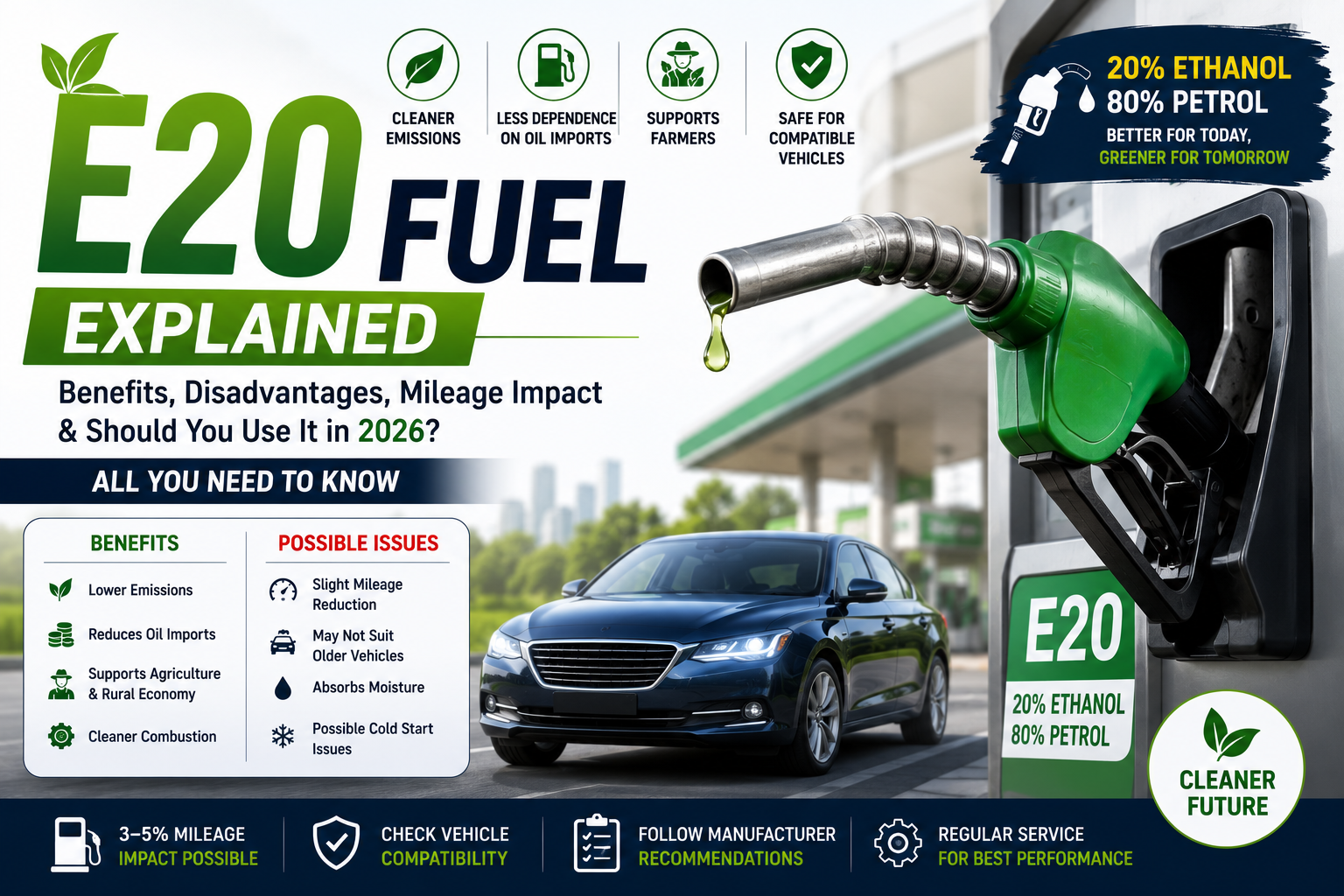
What is E20 Fuel? Everything Every Car Owner Should Know
If you've recently visited a petrol pump, you may have noticed a new label on the dispenser—E20 Petrol. This has left many car owners with several questions.
Is E20 fuel safe? Will it reduce mileage? Can it damage my engine? Should older cars use E20 petrol?

These questions have become increasingly common as India moves towards cleaner and more sustainable transportation. While social media is full of mixed opinions, understanding how E20 works can help you make an informed decision.
In this guide, we'll explain everything about E20 fuel in simple language.
What Does E20 Mean?
E20 fuel is a blend containing 20% Ethanol and 80% Petrol.
Ethanol is an alcohol-based renewable fuel produced primarily from sugarcane, maize, damaged food grains, and agricultural biomass. Instead of relying completely on imported crude oil, India is gradually increasing ethanol blending to reduce fuel imports and lower emissions.
The Government of India has been promoting ethanol blending under its long-term energy security and clean mobility initiatives.
Why is India Promoting E20 Fuel?
India imports a large portion of its crude oil requirements every year. By increasing ethanol blending, the country aims to:
- Reduce dependence on imported crude oil
- Lower vehicle emissions
- Support Indian farmers through higher ethanol production
- Improve energy security
- Promote cleaner transportation
- Reduce the country's carbon footprint
Benefits of E20 Fuel
1. Lower Vehicle Emissions
E20 fuel burns cleaner than conventional petrol and helps reduce carbon monoxide and certain harmful emissions released into the atmosphere.
2. Supports Indian Farmers
Ethanol production creates additional demand for crops such as sugarcane and maize, generating new income opportunities for Indian farmers and ethanol producers.
3. Reduces Oil Imports
India spends billions of dollars every year importing crude oil. Higher ethanol blending reduces dependence on imported fossil fuels and strengthens the country's energy security.
4. Cleaner Combustion
Ethanol contains oxygen, which helps improve combustion efficiency and may reduce carbon deposits inside the engine over time.
5. Environment Friendly
Using renewable ethanol contributes to India's environmental goals and supports cleaner mobility.
Disadvantages of E20 Fuel
1. Slight Reduction in Mileage
One of the most noticeable effects of E20 petrol is a small reduction in fuel economy.
Ethanol contains less energy than petrol, so vehicles generally deliver around 3–5% lower mileage, depending on driving conditions and engine tuning.
2. Older Vehicles May Face Compatibility Issues
Cars manufactured before E20 compatibility became common may have fuel system components that were not originally designed for higher ethanol blends.
Using E20 regularly in such vehicles without manufacturer approval may lead to long-term wear of rubber seals, fuel hoses or other components.
3. Moisture Absorption
Ethanol naturally absorbs moisture from the atmosphere. Vehicles that remain unused for long periods should be serviced regularly and stored properly.
4. Cold Start Performance
In some older petrol engines, cold starting may not be as smooth compared to conventional petrol.
Is E20 Fuel Safe for Your Car?
The answer depends on your vehicle.
If your vehicle is E20-compatible, manufacturers recommend that you can safely use E20 petrol.
Most petrol vehicles launched from 2023 onwards are designed or updated to support E20 fuel.
If your car is older, always check your owner's manual or consult your authorised service centre before switching permanently.
How to Check if Your Vehicle Supports E20
- Read the owner's manual.
- Check the fuel lid sticker.
- Visit the manufacturer's website.
- Ask your authorised dealership.
- Contact customer support.
Which Car Brands Support E20 Fuel?
Many manufacturers now offer E20-compatible petrol vehicles.
- Maruti Suzuki
- Hyundai
- Tata Motors
- Mahindra
- Kia
- Toyota
- Honda
- Renault
- Nissan
- Volkswagen
- Škoda
- MG Motor
Compatibility depends on the specific model and year of manufacture, so always verify before using E20 regularly.
E20 Fuel: Pros & Cons
| Benefits | Disadvantages |
|---|---|
| Cleaner emissions | 3–5% lower mileage |
| Supports farmers | Not suitable for some older vehicles |
| Reduces crude oil imports | Higher moisture absorption |
| Cleaner combustion | Possible cold-start issues in older engines |
| Eco-friendly fuel | Compatibility should always be verified |
Should You Use E20 Fuel?
If your vehicle manufacturer has certified your car for E20 petrol, there is no reason to avoid it.
However, if your vehicle is older than 2023 or you are unsure about compatibility, check with the manufacturer before making E20 your regular fuel.
Following the manufacturer's recommendation is always the safest approach.
Expert Tips for Car Owners
- Always use fuel recommended by the manufacturer.
- Service your vehicle on schedule.
- Replace fuel filters as recommended.
- Do not ignore engine warning lights.
- Avoid storing fuel for long periods.
- If you notice rough idling, poor mileage or performance issues after switching fuel, consult an authorised service centre.
Frequently Asked Questions
Will E20 petrol reduce mileage?
Yes. Since ethanol contains less energy than petrol, most vehicles may experience around 3–5% lower fuel economy.
Can E20 damage my engine?
E20 is considered safe for vehicles that are designed or certified for E20 fuel. Older vehicles should follow the manufacturer's recommendations.
Can I use E20 in my old petrol car?
Only if the manufacturer confirms that your specific model is compatible with E20 petrol.
Is E20 better for the environment?
Yes. E20 helps reduce dependence on fossil fuels and lowers certain vehicle emissions compared with regular petrol.
Final Thoughts
E20 fuel is an important step towards cleaner mobility and reduced dependence on imported crude oil. For modern E20-compatible vehicles, it offers environmental benefits with only a slight reduction in mileage.
However, owners of older petrol vehicles should verify compatibility before making the switch. Understanding your vehicle's fuel requirements and following the manufacturer's recommendations will help ensure reliable performance and long engine life.
Stay connected with AurixAuto for the latest automobile news, maintenance tips, buying guides, vehicle inspections, EV updates and expert automotive advice.
Disclaimer
This article is published for general informational and educational purposes only. The information has been compiled from publicly available sources, official government notifications, automobile manufacturer communications, industry reports, and other reliable publications available at the time of writing.
AurixAuto does not claim ownership of third-party trademarks, logos, brand names, government notifications, or publicly available factual information referenced in this article. All trademarks and brand names belong to their respective owners.
While every effort has been made to ensure accuracy, vehicle specifications, fuel compatibility, government policies, prices, regulations, and technical recommendations may change over time. Readers are advised to verify the latest information with their vehicle manufacturer, authorised dealership, or relevant government authority before making any vehicle or fuel-related decisions.
AurixAuto shall not be held responsible for any loss, damage, or inconvenience arising from the use of information provided in this article.