AI Dashcam vs Normal Dashcam: Which One Should You Buy in 2026?
Dashcams have become almost like a safety accessory for modern cars. With busy roads, sudden braking, wrong-side driving and insurance disputes, having a camera recording your journey can be very useful. But in 2026, buyers have one more choice to make — AI dashcam vs normal dashcam.
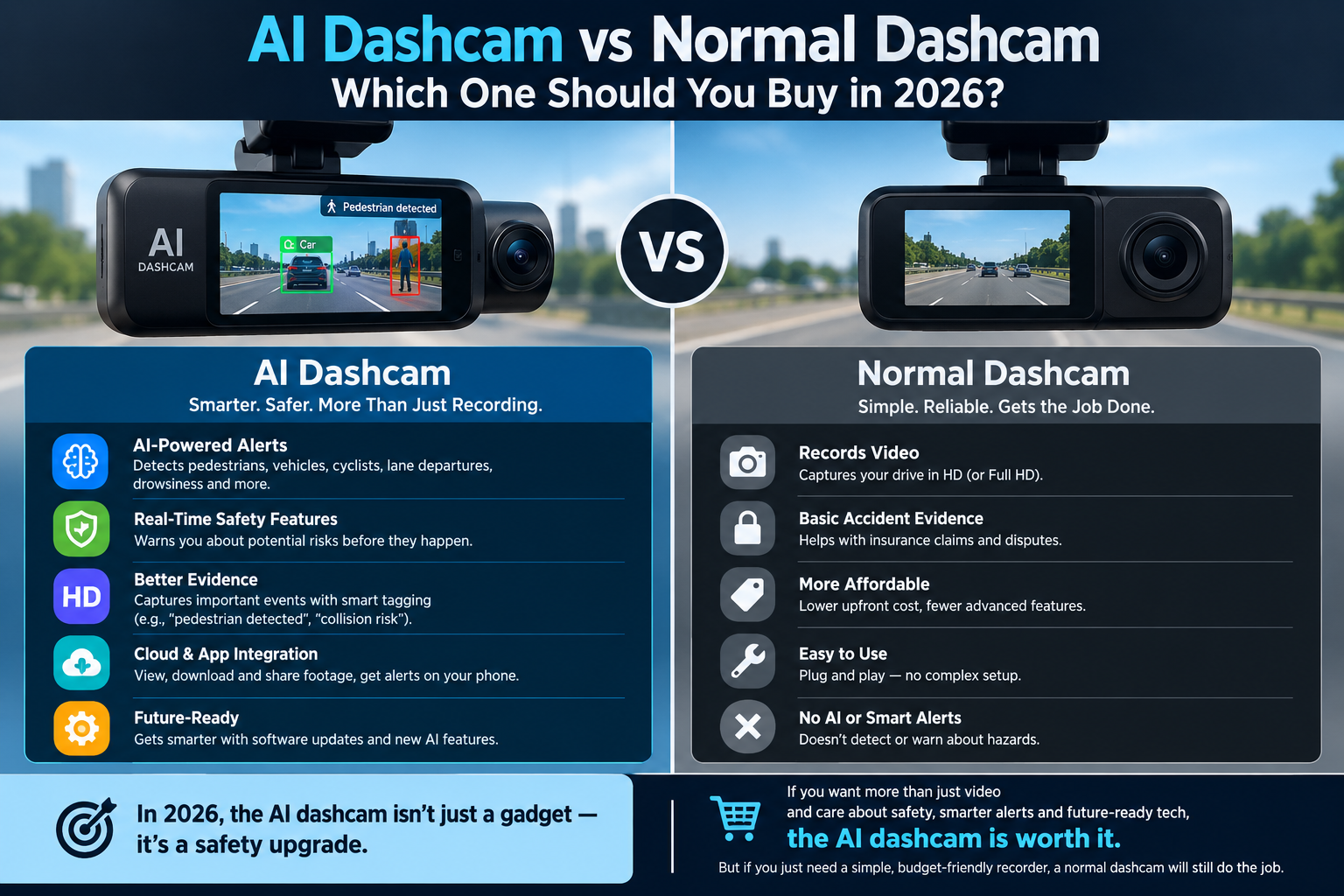
A normal dashcam mainly records what is happening in front or around your car. An AI dashcam goes one step further by analysing the road and, in some models, the driver also. It can provide alerts for lane departure, forward collision, driver distraction or fatigue. :contentReference[oaicite:0]{index=0}
So, which one should you buy in 2026? The answer depends on your driving habits, budget and what you actually expect from a dashcam.
What Is a Normal Dashcam?
A normal or traditional dashcam is basically a video recorder installed inside your car. It continuously records the road and stores the footage on a memory card. When an accident happens, you can use the recording as evidence for an insurance claim or to understand what actually happened.
Common features of a normal dashcam
- 1080p, 2K or 4K video recording
- Front or front-and-rear camera setup
- Loop recording
- G-sensor for accident detection
- Parking monitoring on selected models
- Night recording
- MicroSD card storage
- GPS and Wi-Fi on some models
The biggest advantage is simplicity. You install it and it records. You don't need to learn many complicated features.
What Is an AI Dashcam?
An AI dashcam uses software and artificial intelligence to understand what its camera is seeing instead of simply recording video. Depending on the model, it can identify risky driving situations and provide alerts in real time. :contentReference[oaicite:1]{index=1}
Some advanced systems also use a cabin-facing camera for driver monitoring. This can detect signs of fatigue, distraction, phone usage or the driver looking away from the road. Road-facing AI can offer features such as forward collision and lane-departure warnings. :contentReference[oaicite:2]{index=2}
Important AI dashcam features
- Forward Collision Warning: Warns when you are getting too close to a vehicle ahead.
- Lane Departure Warning: Can alert you if the vehicle appears to move out of its lane.
- Driver Monitoring: Selected models can detect fatigue and distraction.
- Event Detection: AI can identify certain risky events automatically.
- Cloud Connectivity: Some premium systems can upload important footage.
- Driver Coaching: Useful especially for commercial vehicles and fleets.
AI Dashcam vs Normal Dashcam: Key Difference
| Feature | Normal Dashcam | AI Dashcam |
|---|---|---|
| Video Recording | Yes | Yes |
| Accident Evidence | Yes | Yes |
| ADAS Alerts | Usually No | Often Available |
| Driver Monitoring | Usually No | Available on selected models |
| Real-Time Alerts | Limited | Yes, depending on model |
| Price | Generally lower | Generally higher |
Which Is Better for Indian Roads?
This is where things become slightly interesting. AI sounds better on paper, but every AI feature is not equally useful in real-world driving. Lane markings in Indian cities can be faded or missing, traffic can be unpredictable and vehicles often change lanes suddenly. Because of this, camera-based ADAS alerts may sometimes be inconsistent. :contentReference[oaicite:3]{index=3}
So don't buy an AI dashcam only because the box says “AI”. First check the camera sensor, night recording, heat resistance, storage, parking mode and reliability.
AI Dashcam: Pros and Cons
Pros
- Provides additional driving alerts
- Can detect driver fatigue or distraction on supported models
- Useful for highway and long-distance driving
- Better suited to commercial vehicles and fleets
- Can provide smarter event detection
Cons
- Usually costs more than a basic dashcam
- Some alerts can be annoying or inaccurate
- Advanced features may require additional hardware or subscriptions
- Privacy can become a concern with cabin cameras and cloud-connected systems
Normal Dashcam: Pros and Cons
Pros
- More affordable
- Simple to operate
- Good for accident evidence
- Lower complexity
- Many good options are available for personal cars
Cons
- Does not actively analyse driving in most models
- Limited driver safety alerts
- Basic models may have poor night footage
- Some low-cost models compromise on build quality
What Should You Check Before Buying a Dashcam in 2026?
1. Night Video Quality
Don't get impressed only by 4K written on the box. A good image sensor and proper HDR can be more important for getting readable footage at night. A high-resolution camera with a weak sensor may still produce poor night footage. :contentReference[oaicite:4]{index=4}
2. Front and Rear Recording
A dual-channel dashcam records both front and rear. For many private car owners, this is a more useful upgrade than paying extra only for fancy AI features.
3. Parking Mode
If your car is often parked outside, parking mode can be very helpful. Some systems need a hardwire kit for extended parking monitoring, so check this before buying. :contentReference[oaicite:5]{index=5}
4. Heat Resistance
Indian summers can be hard on electronics, especially a camera sitting behind the windshield. Look for a dashcam designed for high temperatures and consider models using a supercapacitor where appropriate. :contentReference[oaicite:6]{index=6}
5. GPS and Wi-Fi
GPS can store route, location and speed information, while Wi-Fi makes transferring clips to your phone much easier. These are not mandatory, but they can make everyday use more convenient. :contentReference[oaicite:7]{index=7}
AI Dashcam or Normal Dashcam: Which One Should You Buy?
If your main purpose is accident recording, insurance evidence and basic protection, a good normal dashcam is still enough in 2026. You can spend the extra money on a better sensor, dual cameras, GPS and a reliable parking mode.
But if you drive long distances frequently, manage taxis or commercial vehicles, or specifically want driver monitoring and real-time safety alerts, an AI dashcam can be worth the extra money. AI dashcams are especially useful where driver coaching and prevention are important, rather than only recording an incident after it happens. :contentReference[oaicite:8]{index=8}
Final Verdict
The AI dashcam vs normal dashcam debate does not have one answer for everyone. A normal dashcam is a smart and affordable choice for basic protection, while an AI dashcam is better for buyers who want additional safety intelligence.
For most private car owners in 2026, I would suggest first buying a dashcam with good night vision, front + rear recording, parking mode, GPS and strong heat resistance. After these basics are covered, AI features become a nice upgrade. In simple words, buy a good camera first, and AI second.
Frequently Asked Questions
Is an AI dashcam better than a normal dashcam?
AI dashcams offer additional safety features such as driver monitoring and ADAS alerts, but a normal dashcam can be better value if you mainly need reliable accident footage.
Do AI dashcams prevent accidents?
They can provide warnings that may help a driver react earlier, but they should not be treated as a replacement for the driver's attention or the vehicle's factory-fitted safety systems.
Is 4K necessary for a dashcam?
Not always. Sensor quality, HDR and night performance can matter more than resolution alone, especially when recording number plates in difficult lighting.
Which dashcam is better for long highway trips?
An AI dashcam can be useful for frequent highway drivers because of features such as forward-collision, lane-departure or fatigue alerts. However, these alerts should be treated as assistance and not as a substitute for safe driving.